

Chapter 1
The resume is theatre
PDF page 15In this chapter
A strong resume can make a hiring decision feel half finished before you've met the person. You recognise the companies, the titles resemble the role you're filling, and the years of experience seem reassuring. By the time the interview begins, you may already be looking for reasons to confirm your first impression.
I've trusted that feeling. The mistake is easy to make because the information isn't necessarily false. Someone may have held the title, worked for the company and contributed to the result. What remains unclear is how they did it, what others supplied and whether the conditions in your business will let them do it again.
The resume is a performance in this limited sense: the applicant chooses what you see and how it is presented. That's a reasonable response to being asked to compete for a job. It gives you a reason to check the account, not a reason to assume the person is dishonest.
The trouble begins when we treat that selected account as enough evidence to decide who deserves a closer look. We can exclude capable people before we know what they can do, while giving a familiar-looking career more credit than it has earned.
What the title doesn't tell you
PDF p. 15Think about the best hire you've made and what made their work valuable. The answer probably needs more detail than a job title. Perhaps they could find the cause of a recurring error, explain an unwelcome trade-off to a client or keep several people working towards the same result. Those are things you can investigate. The title is only a clue about where to start.
Consider a hypothetical engineer moving from a large company to a small business. In the previous role, another team may have decided priorities, tested the work and handled urgent customer problems. In the new role, the engineer may need to do all three as well as build the product. The technical experience still counts. The question is which additional requirements the move introduces and what evidence you have about them.
If the engineer struggles, it would be premature to conclude either that the experience was worthless or that the person simply needs a nicer environment. You might have misjudged a capability, provided too little support or combined several jobs into one. Understanding the difference changes what you should do next.
The iceberg image brings us back to the conditions around the visible record: the team, tools, authority, support and the person's own contribution. Those are questions about context that the summary alone cannot settle.
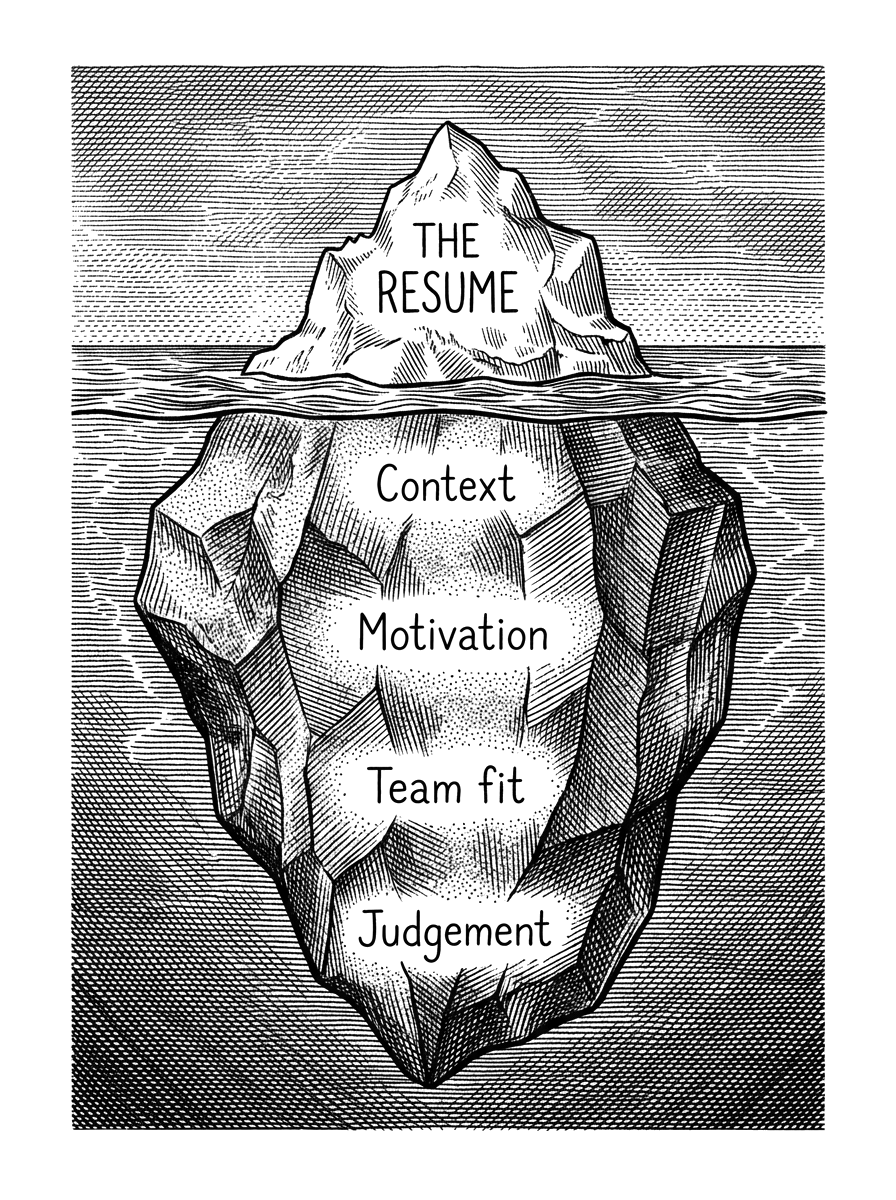
A candidate who says they grew an account may have led the decision that mattered, carried out an established plan or benefited from a change outside their control. Ask what happened, what they decided, what other people did and what evidence would let you check the result. You are trying to understand their contribution, not catch them out for having worked with others.
The same standard should apply to a less impressive-looking background. A person in a smaller company may have done substantial work without the title your search expects. If the role requires a capability, decide how someone can demonstrate it. Don't insist on one career route merely because it is easy to recognise.
A summary is not a selection system
PDF p. 18When we ask a resume to serve as a complete, consistent record for selection, we make it a failed data structure. It cannot supply everything the decision needs.
Applicants choose different information. One describes responsibilities, another lists results, and another gives little detail because their previous work was confidential. Some have had help writing the document. Others haven't. Comparing the polish of those accounts is easier than comparing the work, but it answers a different question.
You can improve matters by asking everyone for the same small set of relevant information. If a qualification is required, ask for it directly and check it. If the role involves resolving client problems, ask for a brief example and specify what you need to understand. Give people a reasonable way to describe comparable work from another setting.
That still relies partly on self-report. It becomes useful when you treat it as evidence to examine alongside other evidence. A precise account you can follow up is more helpful than a broad claim such as excellent communication skills, whichever document contains it.
There is also a limit to what an employer can reasonably ask at the first stage. A candidate hasn't yet learned whether the job suits them. Requiring a long unpaid project from everyone who expresses interest solves your information problem by transferring the cost to them. The answer to a weak first screen is a better, proportionate first screen.
What the research supports
PDF p. 19Selection researchers ask how well information gathered before hiring predicts later job performance. That question is related to the quality of a resume, but it isn't the same thing. Years of experience, job knowledge, interviews and work samples are different measures. A finding about one shouldn't be presented as a direct test of every resume or every person with that background.
Frank Schmidt and John Hunter brought together a large body of selection research in 1998.1 Their synthesis became influential partly because it let practitioners compare common methods. Those estimates have since been revisited. Paul Sackett and colleagues found that earlier statistical corrections had overstated many estimates, and the changes affected their relative standing.2
Structured interviews emerged particularly strongly in that revised research. A subsequent discussion by the researchers also emphasised the variation hidden by an average. Selection should consider the particular job, the quality of the assessment and its costs and consequences. There isn't one method that is best for every role.3
For a hiring decision, that means gathering evidence of relevant capability through well-designed questions and, where appropriate, a work sample. A count of years or a familiar employer cannot establish that someone meets your requirements. Skill still matters. You need evidence of it that bears on the job.
The design matters as much as the label. Calling an exercise a simulation does not make it representative of the job. Calling an interview structured does not help if each candidate faces different standards or the questions test something irrelevant. You still have to explain what you're trying to learn and how the evidence will inform the decision.
The interview can improve on the page
PDF p. 20An unstructured interview can become a second performance. The candidate tells the stories they have prepared, the employer describes the company at its best, and an easy conversation becomes evidence of fit. It can feel revealing without testing much that the job will require.
A structured interview has a different purpose. You decide which requirements to examine, ask comparable questions and assess answers against criteria set in advance. You can follow up to clarify an answer while keeping the underlying standard consistent. The question is whether you obtained relevant evidence, not whether every conversation sounded identical.
Suppose a role requires someone to handle conflicting client requests. You might ask each candidate to describe a time they had to choose between competing commitments. What was promised? What could they change? Who needed to agree? What did they communicate, and what happened? An answer becomes useful through those details, not through the candidate's confidence alone.
A pause doesn't prove depth. A fluent answer doesn't prove superficiality. Some people need a moment to organise their thoughts, some communicate most clearly in writing, and some have practised telling a true story well. Judge the content against the requirement, and consider an appropriate way for the candidate to demonstrate it.
We also need to notice affinity bias, the pull towards someone who seems familiar. Enjoying the conversation is real information about that conversation. It is not sufficient evidence of how the person will handle a client escalation or a difficult handover. Keep those judgements separate in your notes.
Daniel Kahneman and Amos Tversky described the illusion of validity, in which a coherent account can support confidence beyond what its predictive evidence warrants.4 That is a useful warning for an interviewer. If you're certain about a candidate, ask which observations support that certainty and what important requirement remains untested.
Structure also matters when you combine evidence. Research comparing rule-based and overall judgement approaches has often favoured consistent combination over an assessor's final impression. The size and reliability of the advantage vary across analyses and outcomes.5 That is a reason to set requirements beforehand, record evidence separately and explain whether a strength can compensate for a weakness. It is not evidence that any particular score you devise will predict performance.
What AI changes about the document
PDF p. 21AI can help an applicant describe their experience more clearly, and that assistance isn't proof of dishonesty. It can also make a vague account sound specific and confident. From the employer's side, polished language is an increasingly poor reason to stop asking questions.
The same caution applies to screening. Software can help organise applications, but a rule that rejects relevant experience under an unfamiliar title can discard people you would otherwise want to assess. Automating the rule doesn't make the requirement sound.
Harvard Business School and Accenture's 2021 Hidden Workers report examined how recruiting practices can exclude qualified people. Employers reported that exacting criteria could screen out people able to do the work.6 That is evidence of a problem worth checking, not a measured error rate for every hiring system or a claim that every rejected applicant is qualified.
Chapter 2 examines the pressure this creates for applicants and employers. For now, the useful distinction is between improving someone's account and establishing that the account demonstrates the required work. You can prompt-engineer a resume. You still need to investigate the match.
A work sample with a clear purpose
PDF p. 22Imagine you are hiring a customer-support lead who must handle requests the business may not be able to meet. Decide what the person must know on arrival and what you will teach. Work samples and job-knowledge tests are less suitable when they test knowledge or skills candidates will develop after hiring.3 Here, you want evidence of judgement using information you supply.
You might give shortlisted candidates three invented or properly anonymised tickets, the relevant policy and enough information about their authority. Ask them to explain their next steps and draft one response. Tell them the time allowed, which tools they may use and whether AI assistance is permitted. Offer a route to request an adjustment, and pay for substantial work.
Set the criteria before reading the responses. You might look for accurate use of the supplied facts, a sensible escalation where authority is missing, a clear response to the customer and attention to any recurring problem. Have someone who understands the work assess it. A candidate should not lose marks for failing to guess an internal policy you withheld.
The sample can show how someone approached that task under those conditions. It can't establish everything about leading a support team, working over several months or learning an unfamiliar product. Use other evidence for those questions. The candidate should also have a chance to ask what the exercise reveals about the real job.
The conversation about motivation needs the same attention to the actual work. Ask what attracts someone to the duties, which conditions matter and what trade-offs they would accept. Those answers tell you more than generic enthusiasm. Someone who needs a dependable income can still care deeply about doing good work, and financial need should not become a test of character.
When there are 400 applicants
PDF p. 23You cannot have a long conversation with all 400 applicants. Narrowing that field needs an explicit process.
First, distinguish essential requirements from preferences and things you can teach. Check whether each supposed essential really follows from the work. A legal qualification may be essential. Experience in your exact software might not be, especially if an experienced person could learn it quickly.
Ask for a small amount of relevant first-stage information. That might be a qualification check, availability for genuinely necessary working hours and one brief account of comparable work. Explain the process and the pay range so people can decide whether to continue. Don't ask for personal details that have no bearing on the requirement.
Use the same criteria to make a manageable shortlist. Have a person review uncertain cases rather than treating missing wording as proof of missing capability. Keep a record of the reason for exclusion, and allow a material error or missing fact to be corrected. A candidate with an unconventional background should be able to show equivalent evidence.
Reserve the more demanding assessment for a smaller group. Tell those people what will be involved before they agree, then assess the work consistently. This doesn't eliminate judgement or guarantee that you will identify every capable applicant. It makes the judgement more relevant and gives you something specific to examine if the process fails.
A resume may supply useful information at several points in that sequence. The change is that your understanding of the job determines what you look for, rather than the layout of a career determining what you decide to value.
Mistaking that presentation for the work is the danger in the resume as theatre. Chapter 9 shows how to put a person's background alongside other evidence in a hire. First, we need to understand why a process that leaves so much unanswered remains so hard to change.