
Chapter 11
The match doesn't end at the offer
PDF page 108In this chapter
An offer records only part of what a candidate agrees to. The conversations around it also create expectations about authority, support, workload, flexibility and the work itself. A role that promised room to make decisions may arrive with an approval requirement nobody mentioned. A manager who promised training may have assumed somebody else would provide it.
When we worked on onboarding at Tier 11, the new starter, hiring manager and capability leader did not always need the same thing at the same time. The starter was trying to understand the systems and the people. The business also needed them to become productive. A plan that made sense to one person could leave another struggling.
We spoke with people as they went through the experience and brought the different expectations together. We kept revising the process through conversations, a first version, feedback and another version.1
We kept learning about the demands we were placing on people instead of treating the first onboarding plan as finished. Those changes do not establish that retention or performance improved.
Carry the promises into the job
PDF p. 108The first useful onboarding document is a short account of what both sides understood. The manager and new employee should be able to read it together and correct it. It needs the early outcomes, the important working conditions, the decisions the person can make and the support required to get started. It also needs the uncertainties you carried into the hire.
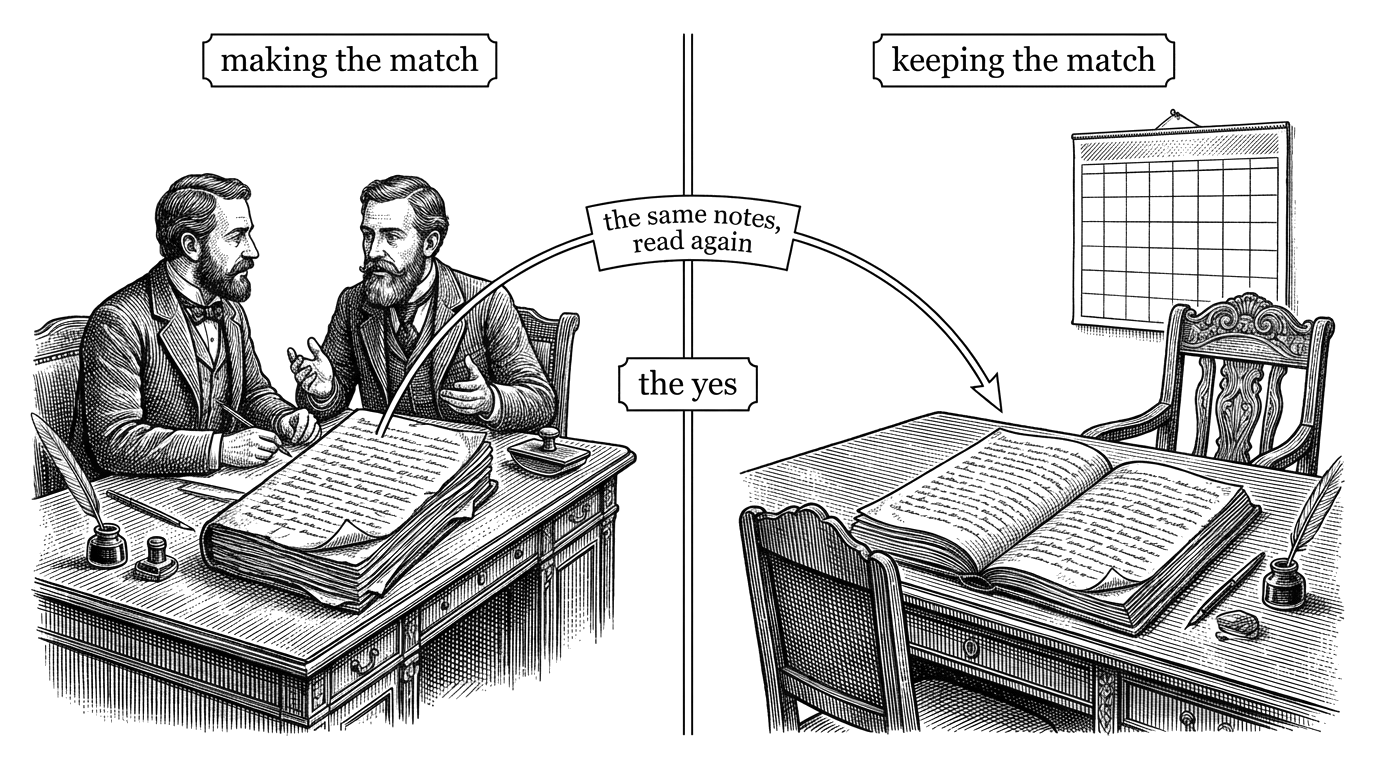
In our illustrative coordinator case, the hiring decision included a trainable gap in agency experience. That should become paid learning time and access to somebody who knows the work. It should not disappear into an assessment folder while the new person is criticised for asking basic questions. The agreed overlap hours should reach the person scheduling meetings. The delivery lead's ownership of priorities should remain visible when the founder wants something done urgently.
Research on newcomer adjustment supports paying attention to these conditions. A meta-analysis by Talya Bauer and colleagues examined role clarity, confidence in doing the work and social acceptance, and their relationships with satisfaction, performance and turnover.2 Those relationships do not establish that an onboarding worksheet will prevent early failures.
Here is a manageable brief for the coordinator, using teaching extracts from our invented case.
| Part of the brief | What it means in this role |
|---|---|
| Early work | Maintain the agreed delivery list, check dependencies and flag risks while there is still time to act. |
| Decision rights | The coordinator maintains the list. The delivery lead decides priorities. Account managers own client promises. The founder decides contract and price exceptions. |
| Support | Provide the promised paid training and a route for questions about agency work. |
| Working conditions | Respect the agreed overlap hours and make any requested change explicit. |
| Known uncertainty | Check whether follow-up remains reliable as the number of active jobs grows. |
| Review | The delivery lead and coordinator compare the brief with actual work at agreed check-ins, including the first-month review. |
Keep private candidate disclosures out of a general management handover unless the person agrees they are needed. A manager needs to know that an agreed working condition matters. They do not automatically need the personal story behind it. A discovery profile should help someone start well, not become a permanent file of explanations about their character.
Renewal is a question, not a retention trick
PDF p. 111I sometimes describe employment as a subscription renewed every day. The useful question is whether the work remains worth choosing for the person doing it. That question keeps the employer's part of the relationship visible after the contract is signed.
The analogy has a limit. Leaving a job can threaten someone's income and security, and the employer usually has more power. A person staying is not proof that the work is right for them. Nor should a difficult week be read as a decision to leave. The work is what we keep examining, not the person's worth or loyalty.
Onboarding is the first renewal in this sense: the first chance to compare the experience with the promise. Ask which parts of the job are as expected, which are different and what is harder than it needs to be. If the person raises a gap, decide whether the company can change it. When it cannot, say so and explain why. Repeatedly inviting concerns without acting on them gives people little reason to keep answering.
Work Drivers can help frame this conversation, provided they stay open to correction. Someone who valued learning during recruitment may now be telling you that constant novelty makes it difficult to become competent. That is not a contradiction to score against them. Ask what kind of learning they meant, what the job is providing and what would help. The earlier discussion is a starting point, not an answer that lasts forever.
Find the problem before choosing the remedy
PDF p. 112When performance falls short, start with the work you can describe. Which requirement was missed? What happened, on what occasion, with what effect? Compare that with the expectation the person received. A complaint that somebody lacks ownership is much harder to investigate than a record that two agreed follow-ups did not happen.
Then test competing explanations. Was the expectation clear? Did the person have the time, information, tools and authority it required? Has the work changed? Did training happen? Is there evidence of a capability gap that the original assessment missed? What does the person say was happening? More than one explanation can be true.
Keep the original hiring judgement open to question. If every successful hire proves the method and every unsuccessful hire proves the manager failed to use it, the method can never be wrong. Choose the explanation from the evidence, including the person's skills, judgement, effort and conduct as well as the conditions.
This makes the manager as enabler a practical role. The manager removes avoidable obstacles, gives clear feedback and holds the agreed requirements. Enabling someone does not mean avoiding a difficult conversation or doing their work indefinitely. It means making sure the conditions and expectations are clear enough that both sides can see what needs to improve.
Turn the conversation into a change
PDF p. 112Return to the invented coordinator case from Chapter 9. At day 30, some hand-offs are still slipping. The founder has sent urgent work directly to specialists outside the shared list. A, the coordinator, has also missed a follow-up for which the necessary information was available. The manager examines the incidents before deciding that A cannot cope or the organisation has failed A.
Both findings belong in the record. The delivery lead asks the founder to route priority changes through the list for two weeks. The founder agrees, and the lead owns checking whether that happens. A practises the follow-up check on the next set of hand-offs, with the promised support, and records commitments in the shared list. They agree to examine the results on day 45.
If the founder had refused, the lead could still help A improve the missed follow-up. But the requested change to how priorities were communicated would remain unagreed. It would be wrong to assess A as though the promised change had happened, or to tell the founder that recording the problem had resolved it.
At day 45, fewer priority changes are missing from the list, but one hand-off still slips. Before expanding A's responsibility, the manager examines it. The cause of that remaining miss is still unknown. It could reveal further learning needed, an unrealistic workload, another broken hand-off or a capability the original assessment missed. The next decision depends on what they find.
Use the first-90-days worksheet to keep the observation, competing explanations, chosen action, owner and date together. Add what changed at the next review. If the action did not help, the explanation or action needs to change.
Ninety days is a convenient planning window here, not a scientific deadline for deciding whether a person belongs.
For some problems the honest decision is that a condition cannot be changed. For others, a reasonable period of support still leaves an essential requirement unmet. Those outcomes also belong in the record. Discovery is not a promise of endless redesign, and a conversation does not replace the need to manage serious conduct or persistent performance problems fairly.
Ask before interpreting the silence
PDF p. 114Someone who used to volunteer ideas may become quieter. Replies may take longer. They may stop raising concerns. These changes can justify a conversation, but they do not tell you that the person has mentally resigned. Workload, unclear priorities, a communication problem or something they do not wish to disclose could all be involved.
Ask about the work and the change you have observed without claiming to know its meaning. You can say that fewer concerns have been raised lately and ask whether there is anything making them harder to discuss. Leave room for an answer you did not expect. Do not monitor pronouns, tone or private messages to build a hidden disengagement score.
The manager does not need a diagnosis of somebody's private life. They need enough understanding to address work requirements and offer appropriate support. The person decides what personal information to share. An agreed adjustment can be recorded without turning its private reason into team knowledge.
Keep the habit proportionate
PDF p. 114Teresa Torres' work on continuous discovery helped me think about learning as an ongoing habit rather than a phase that ends before delivery.3 Applying that idea to employment is an adaptation. An employee is not an interchangeable research participant, and repeatedly asking questions creates obligations for the person asking them.
My practice is to meet more often during a new hire's start, a role change or an unresolved difficulty, then adjust as the work becomes stable. Agree a cadence that suits the job and the person. Weekly meetings may help in one setting and be excessive in another. Their frequency alone cannot tell us whether discovery is happening.
A useful check-in has a question about how the work is going, enough time to explore the answer and a route to action. Some weeks it should be short because the earlier change worked and there is little more to resolve. At other times an established routine needs a longer conversation. Keep the attention consistent without turning every meeting into another assessment.
Where this breaks: Listening can become a way of postponing a decision. If the same issue returns with no action, owner or honest refusal, the process is not helping. Set a review date and decide what evidence would justify continuing, changing the support or acknowledging that the role is not working. Keep that decision open to the possibility that the original hiring judgement was wrong.