
Chapter 4
Discovery before the decision
PDF page 42In this chapter
Early in my HR work, I noticed that we didn't have a performance-improvement process. So I built one and pushed it out. I had found a gap, made something to fill it and expected people to use it.
The response was that it didn't fit what people needed. The timing was wrong. It felt like an off-the-shelf solution. I had treated the absence of a process as evidence that this was the process we needed next. I hadn't done the discovery that might have sent me towards a different solution altogether.1
That is an uncomfortable mistake to admit when your job is to help people work better. Building something feels useful. Asking more questions can feel like postponing the work. But the effort I put into the process did nothing to establish whether I had chosen the right problem.
I've seen the same habit in leadership conversations. Someone asks why good employees are leaving, and the discussion turns to tighter processes, less waste and getting more from the team. Those changes might help. What do people need to do the work well? Which part of the job differs from what they expected? Until we ask, we are choosing a remedy before understanding the problem.
I call the capacity to slow down and understand another person the analogue flame. I recognise how easily that curiosity and attention disappear when I feel I should already know what to do.
The practical name for the work is discovery: investigating the person, problem and conditions before deciding how to act. It includes asking questions, checking accounts against events and changing your explanation when the evidence requires it. It also includes deciding when further enquiry is unlikely to change the choice.
Borrow the discipline, not the certainty
PDF p. 43Teresa Torres describes continuous discovery in product work as regular contact with customers in pursuit of an outcome.2 What I took from her work was the need to keep returning to the people whose experience we were trying to understand. Learning about them could be part of the work itself, rather than research we finished before getting on with it.
That is an influence on this method, not evidence that a product-discovery practice has been validated as a hiring system. The contexts differ. A candidate is making a decision about their livelihood, and an employee may have good reason to be careful about what they tell a manager. We need to account for those conditions rather than copy a practice simply because it worked in another field.
The enquiry continues when you act on what you've learned and examine what happens. A conversation that reveals a problem but changes nothing can become another demand on the person who told you about it.
Make the next step clear. If you can change a condition, say who will act and when. If you need to investigate, say what you will check. If you cannot make the change, explain the constraint. An honest limit is more useful than encouragement that leaves someone expecting a promise you have not made.
Creative strategy, but for people
PDF p. 44In a piece I published about discovery, I described a check-in with a creative strategist who'd recently joined Tier 11. I return to that account here for her insight, not as a documented repair or outcome of the opening hire.
It wasn't a performance review or a survey. I wanted to understand what was working for her, what wasn't and what she needed. We talked about the Work Drivers exercise she'd completed before joining, how her priorities had changed with the move from freelancing to full-time work, and where the lines between her responsibilities and other people's were still blurry.
From her onboarding, the conversation moved to the work itself. She described studying an audience, finding patterns in how the creative performed and looking at the data from different perspectives to check her assumptions. She was trying to catch problems while they were still small. Then she said, "It's like creative strategy, but for people. That's what you guys are doing."
She'd found words for something I hadn't managed to describe. When a piece of creative failed, she wanted to know what it could tell her. She'd use what she learned to change the next attempt, then watch what happened. That constant revision was part of what she enjoyed about the work, even when a failure stung.
Listening to her, I recognised my own work in what she was saying. We were applying the same discipline to different problems, and both depended on being willing to question our first explanation.

An explanation is something to test
PDF p. 45Managers need to make decisions, often with incomplete information. The alternative to a hasty explanation is not endless listening. It is a better account of what you know, what you assume and which uncertainty matters to the decision.
Suppose work is arriving late. A manager says the team needs more ownership. A team member says every decision waits for approval. Another says the brief changes after the work is finished. Each account may contain part of the truth, and each suggests a different response.
If you ask only whether people feel accountable, you may get another conversation about attitudes. Ask about a recent piece of work instead. What was requested? When was the brief agreed? Who could approve the next step? What changed, and who knew? The event gives you something specific to compare.
You are not looking for a person whose account can be declared the whole truth. Someone may understand one part of the process and miss another. Seniority doesn't make an account complete, and agreement among several people doesn't prove it. The aim is an explanation that fits the available evidence well enough to support a responsible action.
Writing the explanation down can expose a gap. There is a difference between saying a person lacks initiative and saying they waited two days for an approval the process required. The first sounds like a trait. The second lets you ask whether they should have escalated, whether the approval was necessary and whether anyone had authority to act in the approver's absence.
Keep alternatives visible until you have a reason to set them aside. Perhaps the person misunderstood the process. Perhaps the manager believes authority was delegated when the employee was never told. Perhaps there are two problems. A useful investigation can make the situation more specific before it makes it simpler.
Ask about what happened
PDF p. 47Broad questions have a place. Asking how the role is going can give someone room to raise an issue you had not anticipated. But when an answer could change a hiring decision or a role design, follow it into an example.
If someone says they thrive with autonomy, ask what autonomy looked like in work they enjoyed. Which decisions could they make? What limits were clear? When did they seek help? If a founder promises autonomy, ask what a new hire could decide without approval during an ordinary week.
You may discover that the same word describes different expectations. One person means choosing how to complete an agreed task. Another means setting priorities. A third means being trusted to challenge whether the task should be done at all. A matching word on both sides is not yet an agreement.
Follow-up questions should help someone explain, not lead them towards your preferred answer. Ask what happened next, what they considered and who else was involved. Where a detail is unclear, say what you have understood and invite a correction. If their account conflicts with another source, explain the conflict without treating it as evidence of bad faith.
There are boundaries. A candidate should not have to disclose personal finances, health information or family circumstances to justify wanting predictable hours or adequate pay. You can discuss the job's requirements and the conditions someone needs without demanding the private story behind every preference.
Would the proposed role have changed the result?
PDF p. 48Take a recent delayed piece of work and compare it with the role you intend to add. Look at when the request arrived, who promised the date, which dependencies were identified and who could change the order of work. Compare the delivery record with the accounts of the people involved.
Put the responsibilities beside one another. Name who owns the result, who contributes and who makes the decision when priorities conflict. Then test the arrangement against the recent job. Would the proposed role have changed what happened? At which point? What would still have waited?
Where the accounts disagree, record the difference. Decide which observation would help resolve it, who can make the role-design decision and what cannot honestly be promised to a candidate in the meantime. A vague instruction to be collaborative leaves the disagreement unsettled.
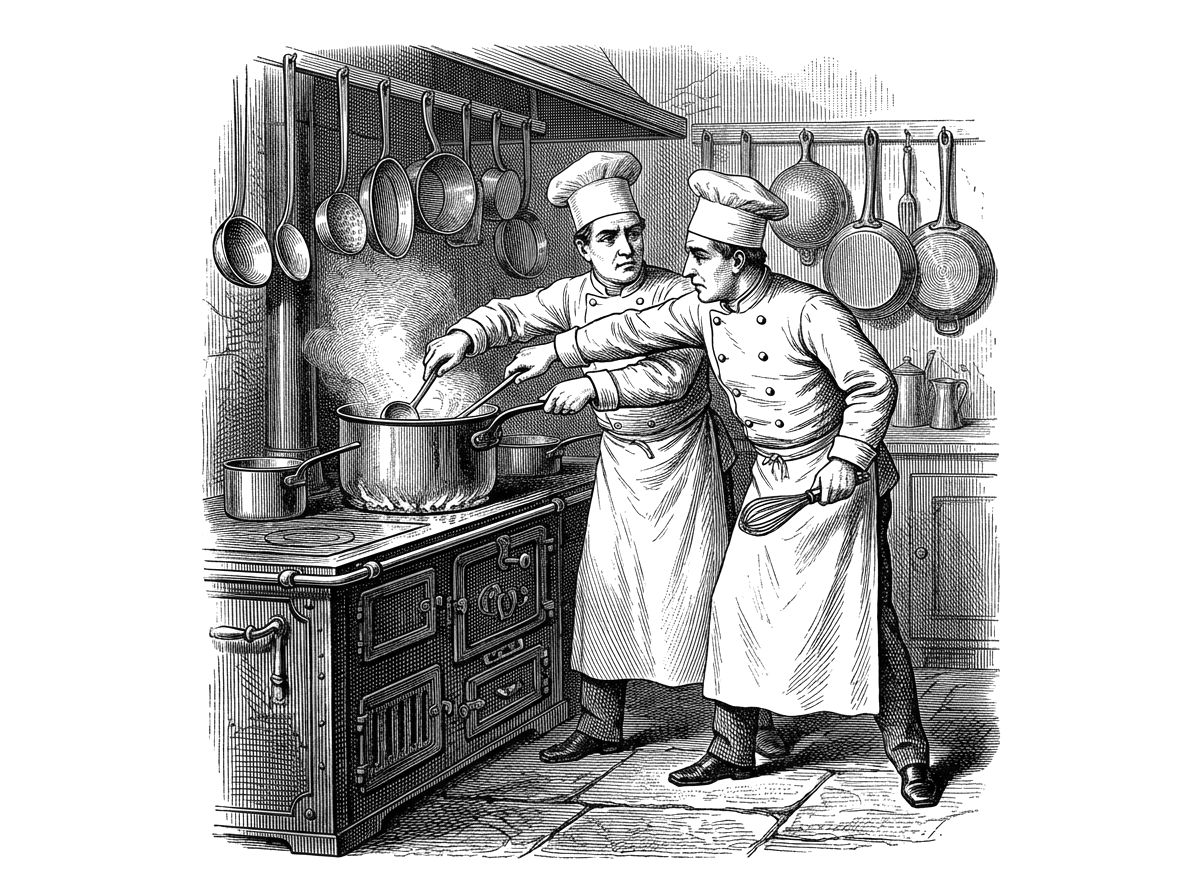
This is the comparison I missed in the failed hire from the introduction. Each strategist's role description looked plausible alone, yet two capable people reached for ownership of the same work: two chefs in one kitchen. The unanswered question sat where their responsibilities met: who could decide what happened next? Adding detail to one description alone would not have settled it. This account does not document a repair or a later outcome.
Four habits you can practise
PDF p. 49The first is to keep track of your assumptions. Before a conversation, note what you think is happening and why. Give yourself a way to notice evidence that doesn't fit that working explanation. If every answer can be interpreted as support, you haven't designed a useful enquiry.
The second is to build shared understanding. Ask, listen and say back what you heard in plain language. Invite the person to correct you. This doesn't require agreement about everything. It means that a disagreement concerns the actual issue rather than two different meanings hidden inside the same word.
The third is to check what happens over time. The work may change after a hire, and a condition that was acceptable at the start may become difficult. Agree when to revisit important assumptions. A new role or a major change may need more frequent attention than stable work. The purpose of the conversation should determine the cadence.
The fourth is to connect what you learn to a decision. A concern may justify a change, a further check or an explanation that the condition will remain. Keep observations separate from interpretations. A slower response to a message is an observation. Concluding that someone no longer cares is an interpretation that needs more evidence.
These habits also apply when you receive unwelcome feedback about the hiring process. If a candidate says an exercise was unclear, don't assume they disliked being challenged. Examine whether the instructions supplied the information the task required. If the instructions were sound, you can explain why. If they weren't, change them and consider whether earlier candidates were affected.
Decide with uncertainty still present
PDF p. 50Discovery cannot guarantee a good hire. People can misunderstand a question, describe their own behaviour inaccurately or act differently when conditions change. You may not have access to the evidence that would settle a difficult judgement. More conversation can sometimes repeat the same uncertainty rather than reduce it.
I recommend a pre-action pause before a consequential decision. Note what you know, what you're assuming and which unanswered question could change your choice. The check may be a short question, a look at recent work or a correction to your notes. It needn't mean another meeting.
If the uncertainty concerns an essential requirement, pause until you have adequate evidence or decide not to proceed. If it concerns something trainable, consider the support available and whether the risk is acceptable to both sides. If it is unlikely to matter, record it without turning it into another assessment stage.
This matters because the candidate's time has a cost too. A process can sound careful while asking someone to repeat themselves across several interviews. Before adding a stage, name the new evidence it should produce and who is qualified to assess it. If you cannot explain that, the stage may be habit rather than care.
You can also discover that the job itself cannot yet be offered honestly. Perhaps leaders disagree about its purpose or nobody will commit to the authority it requires. More candidate interviews won't fix that. Return to the business decision before asking someone to accept the role.
If the hire goes wrong, examine what the process missed as well as what changed afterwards. Having paused does not transfer responsibility for the decision to somebody else.
The pressure to act before understanding will return. A vacancy becomes urgent, a confident candidate becomes available or a client wants a date. You need a process that keeps the important questions visible at those moments, rather than depending on everyone remembering to be curious.
Those questions need a clear account of the work: what someone contributes, the conditions they work under and what both sides expect from the arrangement. A job title leaves too much of that unstated. The next chapter begins there.