
Chapter 8
Skills, context and Work Drivers
PDF page 76In this chapter
- What Work Drivers can help you discuss
- Keep importance, rank and fulfilment separate
- Follow the response into the work
- Discuss an apparent conflict before deciding
- Assess the capability the job needs
- Ask what the previous result required
- Use a framework to widen the questions
- Combine the evidence without hiding a gap
Consider an illustrative candidate who asks for a clearer role. You might hear that as discomfort with ambiguity. Ask what clarity means to them. They may be willing to work through an uncertain problem but unwilling to have three people issue conflicting instructions. Agreeing who decides would help them work without removing uncertainty from the job.
What Work Drivers can help you discuss
PDF p. 76Work Drivers is our set of prompts for exploring what a person wants work to provide. It groups 32 drivers into functional, social and emotional dimensions. The full reference list is in the printed toolkit, available without a service or account.
Functional drivers include practical conditions such as compensation, location, working hours and role clarity. Social drivers include relationships, recognition and opportunities to lead or contribute. Emotional drivers include autonomy, mastery, purpose and the satisfaction of doing work that matters to the person. The groups organise the conversation without ranking some needs as deeper or more deserving.
Their boundaries overlap, and the list cannot give a complete account of human motivation. Let people describe a need in their own words, including something that sits awkwardly under a driver name. Completing our categories matters less than understanding what they are saying.
The ideas have a history. Research on job design examines how features of work relate to motivation, while self-determination theory gives particular attention to autonomy, competence and relatedness.12 Those traditions help explain why I ask about more than salary and tasks.
We have not established that the instrument predicts performance or retention, and it should not be used as a validated selection test.
Keep importance, rank and fulfilment separate
PDF p. 77A driver response can answer three different questions. How important is this to you? Where does it sit relative to the other things you are considering? How well does your current work provide it? The answers are related but not interchangeable.
Our card sort ranks preferences within each dimension. First among functional drivers is not necessarily the person's single most important need across all 32. A trade-off between dimensions needs a conversation, not an overall order invented from separate rankings.
Fulfilment asks how well the current role provides something. It doesn't measure how strongly someone wants it. A person unhappy with current pay may consider pay very important. A low fulfilment number cannot be read as permission to offer less.
Nor does high fulfilment mean someone would readily give a condition up. Predictable hours may be so established in their current job that they rarely mention them. A new role with frequent late requests could still be unacceptable. Ask about the proposed work before inferring whether they would move.
Forced ranking brings a further limit. Moving one item up pushes another down, so the ranks depend on each other.3 Two people placing a driver third haven't necessarily assigned it the same importance. Adding a fulfilment rating doesn't make their ranks comparable. They can expose trade-offs within a person's choices, but they cannot produce a fair league table of candidates.
You can use the printed list without reproducing a formal assessment. Ask which conditions deserve discussion, what the person means by them and where they have experienced them. If you collect ratings, label the question and scale clearly. Ratings collected for different purposes must remain separate.
Follow the response into the work
PDF p. 78Consider two further illustrative responses, this time about autonomy and pay.
One candidate places autonomy high among their emotional drivers. You might assume they want little management. A conversation could reveal that they want control over how to complete an agreed task while welcoming help with priorities. A clear outcome and regular access to a manager could meet that need. You would still need evidence that they can exercise the required judgement.
A candidate with low fulfilment on compensation may need a higher salary. You need to discuss the range and what the role can offer, not infer capability or commitment from the request. If the gap cannot close, the financial requirement gives you a clear reason to part without making a character judgement.
None of these responses produces a score or a verdict. The decision depends on the person's explanation, the actual work and the evidence of their ability to do it.
Discuss an apparent conflict before deciding
PDF p. 79When the role cannot offer a highly ranked driver, first check what it means to the candidate. Explain what the work offers and where its limits lie. There may be a change the company can make or a trade-off the person knowingly wants to accept.
Someone who values variety may prefer a more predictable role for their next career stage. Someone who wants advancement may accept that a small company has no immediate management opening. Their choice need not be yours. Record the agreement without promising that the missing condition will appear later.
Some conflicts remain decisive. If the job requires coverage the person cannot provide and the company cannot change, the arrangement may not work. That conclusion comes from an explicit requirement and a conversation. A difference between two preference profiles cannot establish it.
I would not use a top-driver mismatch as an automatic veto or proof that someone will leave. The framework has not earned that power, nor does it allow an employer to overrule the person's account of their own priorities. Clarify the trade-off, check that the terms are understood and assess the remaining evidence.
Better working conditions also do not justify paying less than the work warrants. I remain interested in ways people can share more fairly in what they help build, including profit share and ownership. A driver ranking doesn't settle how to do that, and I don't have a single answer to offer here.
Assess the capability the job needs
PDF p. 80Understanding what someone wants from work leaves a separate question: can they do what the job requires?
Start with what the person must be able to do on entry. Other capabilities may be learned with the time and support available. If a work sample assumes specialist knowledge you intend to teach, it may exclude people the job was meant to train. Enthusiasm for learning, on the other hand, cannot replace a capability someone must use safely and independently from the beginning.
I can't tell you to accept someone with 70 per cent of the skills without knowing which 30 per cent is missing. One gap may take a few hours of practice. Another may require years of development or an authority the person cannot legally exercise. Name the gap, its consequences, the support needed and when the person must be able to perform.
Then ask whether they want that development. Someone may be capable of learning more customer work without wanting it to become their career. Calling it a growth opportunity doesn't settle the mismatch. An honest training plan needs their informed interest too.
Ask what the previous result required
PDF p. 81Riding a motorbike through busy Bangkok traffic and driving a truck on a quiet Montana highway both involve driving. Each calls on knowledge and judgement the shared label doesn't describe. Which abilities transfer, and which conditions require new learning?
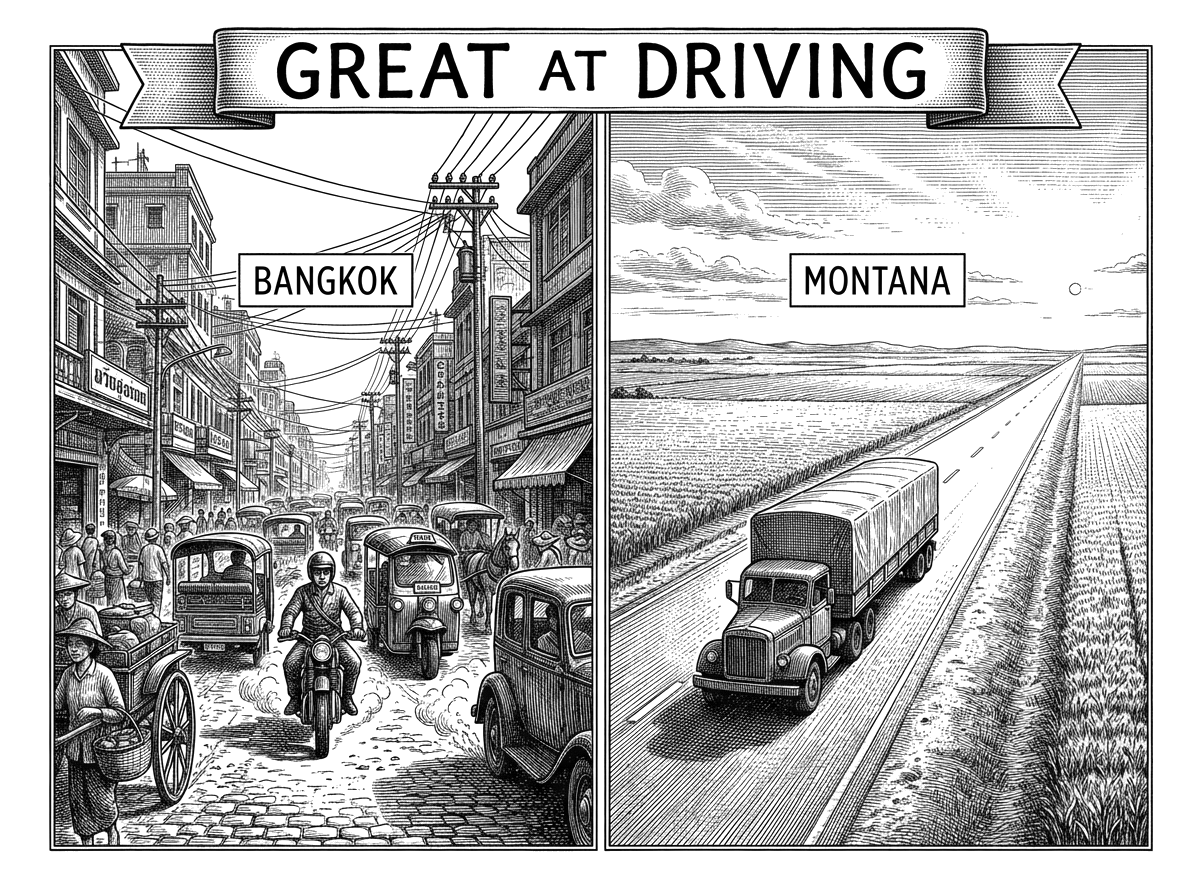
Compare a candidate's previous working conditions with yours. If they managed delivery with a dedicated analyst and you have no analyst, find out who did the analytical work and how dependent the result was on it. You may need to provide support, change the job or assess a capability you had assumed. Removing that support after hiring and treating the changed result as proof of exaggeration would be unfair.
Investigate whether the evidence applies here. A title, employer or certificate cannot settle it alone. Demonstrated expertise continues to matter after someone clears a minimum requirement.
Use a framework to widen the questions
PDF p. 82Joseph Grenny and his colleagues describe six sources of influence in Crucial Influence.4 They consider motivation and ability at personal, social and structural levels: what a person knows and wants to do, and the people, resources and incentives around them.
I find this useful when the first explanation of poor performance is that someone needs to try harder. They may need to change something. The team may also reward the wrong behaviour, a necessary tool may be missing or the manager may have made the required decision impossible. Those possibilities suggest different remedies to test.
These six sources suggest questions to investigate, not measured shares of what caused a result. If one reveals a contextual problem, examine it alongside the evidence of the person's capability.
Combine the evidence without hiding a gap
PDF p. 83Keep the different kinds of evidence visible when you decide:
| Question | Relevant evidence | What it leaves open |
|---|---|---|
| Can they do the required work? | Job-related questions, relevant previous work, knowledge checks and a fair work sample where appropriate. | A limited assessment cannot show every condition or future task. |
| What would help or hinder them here? | Comparison of previous working conditions with the actual role, including authority, tools and support. | The company may describe its intentions more accurately than its current practice. |
| Do the work and terms make sense for them? | Their stated requirements, examples, questions and informed response to an honest preview. | Priorities and circumstances can change, and acceptance cannot guarantee retention. |
When evidence conflicts, stay with the specific uncertainty. Someone may describe independent decisions well but ask for more direction in the task. Was the brief unclear? Did the decision carry an unstated risk? Or does their independent judgement need more assessment? Examine the work and follow up before attaching a personality label.
If you decide that a remaining uncertainty is reasonable to accept, record it with the support promised and what needs checking after the person starts.
To see how these questions change a hire, we need to follow one through the decision.