
She managed $500,000 a month in ad spend across three platforms. Her certifications covered Meta, Google, and TikTok. Her portfolio included a DTC brand where she scaled ROAS from 1.8 to 4.2 in six months. On paper, she was the strongest media buyer you had ever interviewed.
Six weeks in, a client’s Meta campaigns stopped converting. CPAs doubled in 72 hours. The client called your agency at 4:30 on a Friday afternoon, asking what was happening and what you were doing about it.
She froze. Not because she lacked knowledge. Because she had never been in an environment where the answer was “figure it out, right now, with the client on the phone and nobody to escalate to.”
That’s not a knowledge problem. It’s an environment problem. And no certification, portfolio, or reference check is designed to detect it.
Why Resumes Lie About Media Buyers
Media buying has a measurement problem that makes it look easier to evaluate than it actually is. Platform certifications exist. ROAS numbers are concrete. Campaign histories are verifiable. This creates a false confidence: the hiring data seems clear.
It’s not clear. It’s misleading.
Platform certifications test knowledge of a dashboard. They test whether someone can navigate settings, configure audiences, and read metrics. These are necessary skills. They aren’t sufficient skills. The gap between knowing what a frequency metric means and knowing what to do when that metric signals a $500,000 budget is about to become a $500,000 loss? That’s the distance between a technician and a strategist.

Campaign results are equally unreliable as individual performance indicators. In most agencies, campaign outcomes are team outcomes. The strategist set the targeting. The creative team made the ads.
The client approved the budget. The media buyer optimized within constraints that other people defined. Attributing the ROAS to the individual media buyer is like crediting the pilot for the weather.
References compound the problem. A media buyer’s references are typically previous managers who observed platform competence and deadline compliance. They rarely observed the buyer’s behavior during a crisis, because crises at previous employers happened in different contexts with different support structures.
You end up evaluating knowledge, team outcomes, and secondhand impressions. None of these predict what happens when the campaign breaks and the client is waiting.
What Actually Predicts Media Buyer Performance at an Agency
The research on adaptive performance identifies the capabilities that matter in volatile, high-accountability roles: handling emergencies, managing work stress, solving problems creatively, and operating under uncertainty. Platform certifications test none of these.
When we assess media buyers for agency placements, we map four factors that predict whether someone will thrive in the specific seat.
Pace tolerance. Agency media buying runs hot. Clients expect same-day responses. Budgets shift weekly. Creative assets arrive late. Platform algorithms change without notice. Some media buyers are energized by this pace. Others are competent at the work but depleted by the speed. Both are skilled professionals. Only one belongs at your agency.
Decision-making under incomplete data. The best agency media buyers make judgment calls with 60% of the information they want. They know when to act on a partial signal and when to wait for confirmation. The media buyer who needs a full data set before recommending an action will be right when she acts, but she will act too late for your clients.
Client communication style. At most agencies, the media buyer talks to the client directly. This isn’t true in corporate settings, where account managers buffer the relationship. An agency media buyer must translate platform data into business language in real time. The platform language: “Your CPAs increased because frequency hit diminishing returns on your primary audience segment.” What the client needs to hear: “Your ads are reaching the same people too many times, so we’re expanding to a new audience today.” That translation happens on the call, not in a report three days later.
Autonomy orientation. Every role has a behavioral fingerprint. We call the 32 factors that compose it Work Drivers. For media buyers at agencies, the autonomy driver is consistently among the top predictors. The question isn’t whether the candidate can work independently. The question is whether they need to.
Some people hire their work to provide them with freedom and trust. Others hire their work to provide structure and clear direction. Both are valid orientations. An agency that provides no guardrails needs the first. A candidate who needs guardrails will quietly suffer and eventually leave.
The Test That Reveals What Interviews Hide
Interviews reward fluency. The media buyer who speaks confidently about platform mechanics reduces the interviewer’s uncertainty. You feel reassured. You think: this person knows what they’re doing.
But fluency about past campaigns is recall, not judgment. The ability to narrate a successful optimization is a different skill from the ability to navigate a failing one in real time.
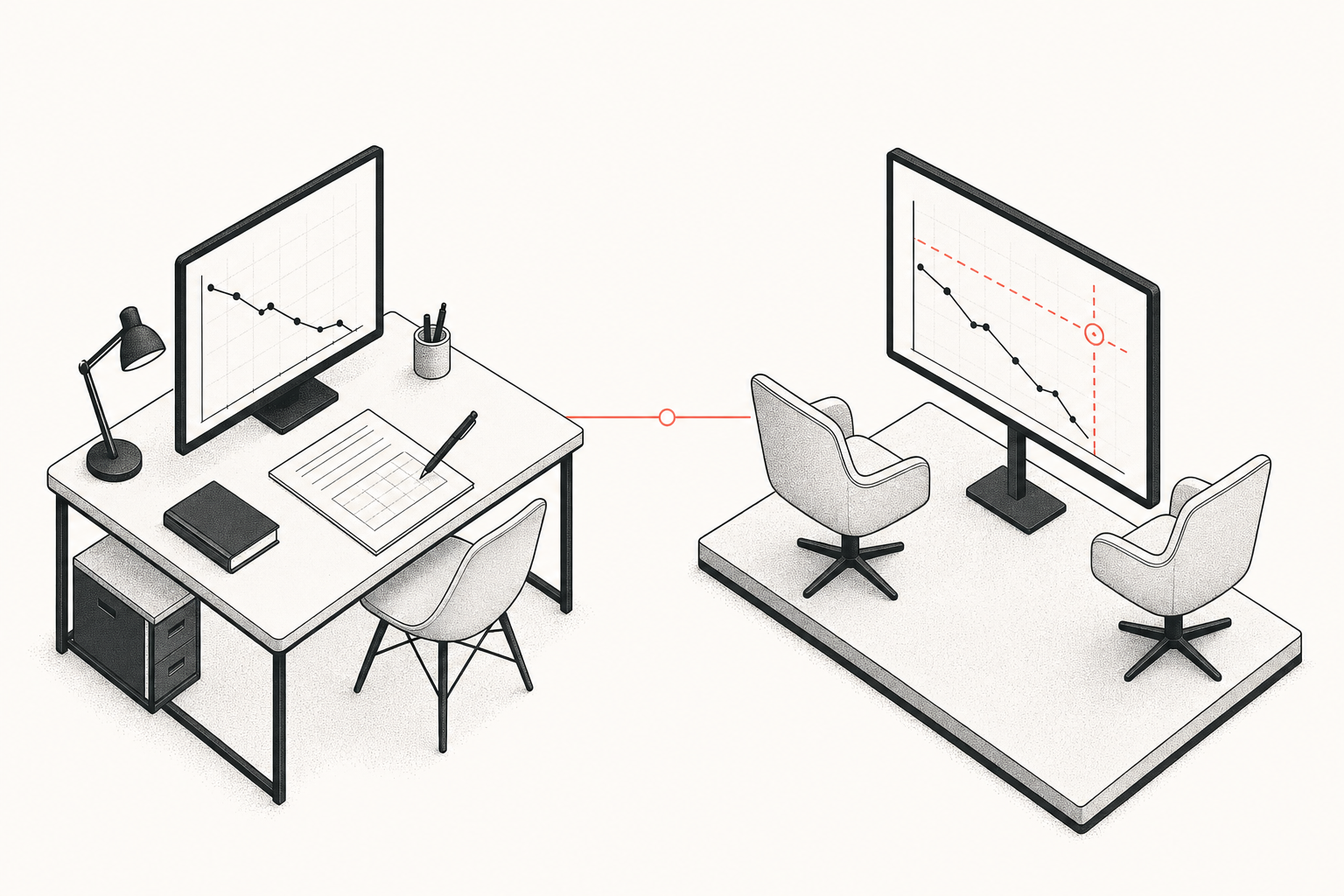
We test media buyers with a scenario we call the Friday Dashboard. A candidate receives a real performance dashboard from an anonymized account: 14 days of data showing a campaign that performed well for eight days and then declined over six. CPAs doubled. Frequency climbed. Click-through rates dropped. The client has an $80,000 monthly budget and a stated goal of maintaining ROAS above 3.0.
The candidate delivers three things. First, a written diagnosis of what is happening and why. This tests analytical reasoning. Second, a prioritized action plan. This tests strategic thinking. Third, a three-sentence Slack message to the client as if it were 4:45 on a Friday afternoon and the data just landed.
That Slack message is the most revealing element of the entire assessment.
It compresses the full role into three sentences: data interpretation, strategic prioritization, client communication, and emotional regulation. Does the candidate default to reassurance? (“Don’t worry, we’re on it.”) Transparency? (“Here’s what we’re seeing and what we’re doing about it.”) Or avoidance? (“Let’s schedule a call Monday to discuss.”)
The reassurance response sounds professional. It’s also the response of someone who hasn’t yet figured out what is wrong and is buying time. The transparency response requires the candidate to have already diagnosed the problem and chosen a course of action before they start writing. The avoidance response tells you the candidate isn’t comfortable making decisions without backup.
In the live portion of the assessment, we walk through the async submission, ask probing questions about the reasoning, and then introduce a constraint the candidate didn’t anticipate. “The client says they can’t increase the budget but also can’t afford to pause the campaign. What do you do now?” We watch whether the candidate updates their thinking or defends their original plan.
This isn’t an interview in a different format. It’s a fundamentally different measurement instrument. Interviews test how well someone talks about work. The simulation tests how well someone does it.
When Discovery Is Not Necessary
Honesty requires this section.
For a mid-level PPC specialist managing $30,000 a month with established creative and a clear playbook, a portfolio review and a technical screen may genuinely be sufficient. The role has defined parameters. The candidate pool is large. “Good enough” and “great” are close together because the scope of judgment is narrow.
Discovery adds the most value for media buyers when three conditions are present. The budget is large enough that a judgment call has material consequences. The role requires client-facing communication beyond platform work. And past hires have failed in ways that technical screening didn’t predict.
If you’ve hired three strong-on-paper media buyers who couldn’t handle the pace, the client expectations, or the autonomy of your agency, the problem isn’t your candidate pool. The problem is that you’re evaluating knowledge when you should be evaluating environment fit.
For role-specific assessment guides, see how we evaluate account managers and operations managers at agencies.
What Defining the Role Reveals
When we map the environment before searching, the search itself changes. You stop looking for “a media buyer with five years of experience and Meta certification.” You start looking for someone whose pace tolerance matches your clients’ urgency. Someone who makes decisions before all the data arrives. Someone who can tell a client what happened, why it happened, and what they’re doing about it, in three sentences, at 4:45 on a Friday.
That’s a different candidate profile. It reaches different people. It produces a different outcome.
The certification proves they know the platform. The simulation proves they know what to do when the platform stops working.
The Friday Dashboard isn’t a hypothetical. It’s drawn from real agency situations our clients have faced. Our discovery process takes three hours of your time. We map the pace, the pressure, and the autonomy your seat demands before we search. We charge a flat $7,500, not a percentage of salary. The guarantee runs 120 days, double the industry standard. 90% of our placements are still in role at 18 months.