
The call comes at 4:30 on a Friday. A client’s paid campaigns are underperforming. The account manager you hired two months ago doesn’t know what to say. So you get on the phone. You handle it. You cancel dinner plans for the third time this month.
You’re back in the role you hired someone to do.
You know the next part. You will manage the client through the crisis. You will have the uncomfortable conversation at next week’s one-on-one. You will start quietly looking at resumes again, wondering what you missed.
You will tell yourself you need to get better at hiring. But the hiring process isn’t where this broke. It broke before you looked at a single resume.
You’ve Been Here Before
This is not your first time. You’ve hired for this role before, maybe twice. Each time, the person had the right experience. They said the right things in the interview. Their references checked out. For the first three weeks, everything felt like relief.
Then something shifted. They couldn’t match the pace. Or they waited for approvals that nobody was going to give. Or they said yes to every client request and created scope creep that burned your delivery team.
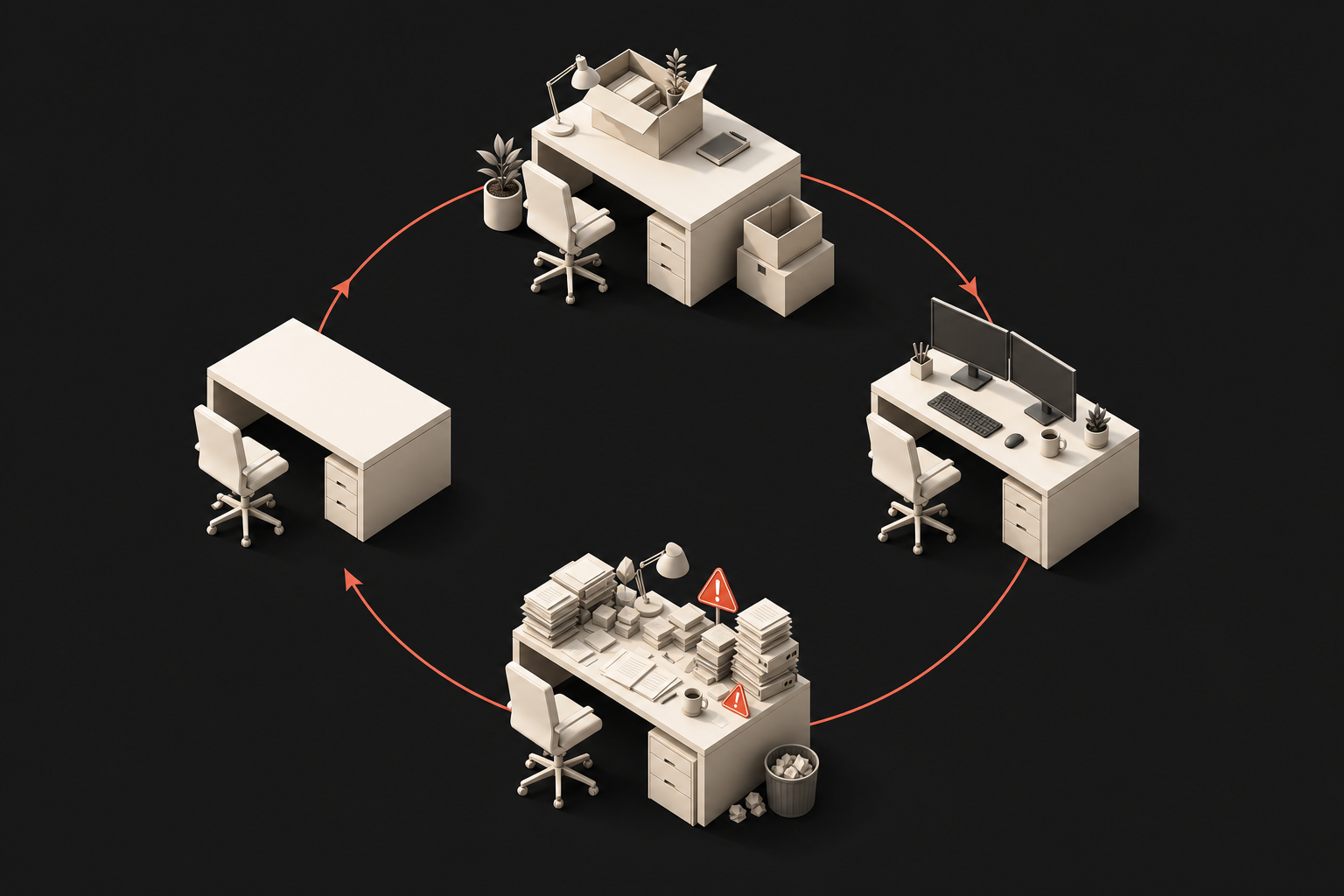
You blamed the candidate. Or the recruiter. Or your own judgment. But the pattern repeated with different people, different recruiters, and different roles. At some point, the common factor stops being luck.
The common factor is what happens before the search starts.
Why This Keeps Happening
When a senior person quits, you absorb their client load. Every week in that state costs you revenue, business development time, and sleep. The pressure to fill the seat isn’t theoretical. It’s physical.
Research on decision-making under time pressure reveals a specific pattern. Urgency reduces the number of evaluation criteria people apply by 40 to 60 percent (Rynes et al., 1991). You don’t just move faster. You literally see fewer dimensions of the candidate. The hire looks right because you stopped examining half the picture.
This is not a discipline problem. It’s how brains work under pressure.
There’s a second mechanism working alongside urgency. When your last good hire was a scrappy generalist who figured things out, that person becomes your template. Every new candidate gets measured against the memory of someone who worked. You hire for the feeling of the last success rather than the function of the current seat.
Research on prototype matching in hiring confirms this produces teams that are culturally similar but capability-redundant (Highhouse, 2008). You aren’t cloning your best people on purpose. But urgency and memory conspire to make it happen.
You aren’t bad at hiring. Your brain is doing what brains do when the pressure is real and the stakes are high.
The Job Description That Is Actually Three Jobs
Agency culture celebrates the generalist. “We all pitch in.” “No job is too small.” This is genuine, and it’s also a structural trap when you hire.
Look at your last job description for a senior role. It probably asked for account management, strategic thinking, and new business development support. That’s three different skill sets, three different personality profiles, and three different experience bases compressed into one title.
No single candidate will excel at all three. But the job description doesn’t separate them. So you evaluate candidates against a blurred composite. The person who is excellent at account management but weak at strategy gets judged as underperforming “the role.”
The role was actually three roles. That’s not a hiring failure. It’s a role definition failure.

This distinction matters. When you think the problem is “wrong person,” the solution is “pick better.” When you realize the problem is “impossible job,” the solution is “define the seat before searching for the person.” Those lead to completely different actions.
What a Bad Hire Actually Costs Your Agency
The financial cost of a bad hire averages $240,000 for a $100K salary position (SHRM). That number understates what happens at agencies, where every hire touches clients directly.
Here’s the cascade that plays out. Weeks one and two: the client notices something is off. Response times change. Questions get asked that were already answered. Weeks three and four: the client raises it with you. You reassure them.
Weeks five through eight: you start shadowing the hire on client calls, doing two jobs simultaneously. Weeks nine through twelve: the client issues an ultimatum or starts talking to your competitors.
By the time you fire the hire at month three, the client relationship is damaged in ways that take six months to repair. If it’s repairable at all.
Founder regression is the cost nobody calculates. When the hire fails, you absorb the role. You stop selling. You stop building partnerships. You stop thinking about the business. In a 15-person agency, your time is worth $400 to $800 per hour in business development value. Twenty hours a week doing work you hired someone to do costs $400,000 to $800,000 in annualized opportunity cost.
Agencies stuck at a revenue plateau are almost always stuck because the founder can’t stop doing $50-per-hour work.
Team morale drops in a step function, not a slow decline. In a 12-person agency, every person’s performance is visible to everyone else. When your team watches a bad hire receive the same pay for inferior work, trust erodes. Your strongest performer starts updating their LinkedIn profile. Not because of the bad hire directly. Because the bad hire revealed that your judgment on the thing they care about most, who they work with, couldn’t be trusted.
Each failed hire makes the next one harder. When you go back to market, you’re more desperate and more gun-shy. The last person you let go told five people in the industry that the role wasn’t what was described. Your candidate pool for round two is smaller and lower quality than round one. This is a cycle that agencies get trapped in for years.
If you’re evaluating recruiting agencies right now, here’s what most of them actually do and what they skip.
The Problem Was Never Candidates
You’ve probably told yourself the market is the issue. Too many junior people claiming senior experience. Too many corporate operators who can’t function without a support team.
That’s partially true. The market is competitive. But the market didn’t write your job description.
Across our engagements, 78% of roles are fundamentally misframed before search begins. The job description captures tasks and experience requirements. It doesn’t capture the environment those tasks exist in: the pace, the ambiguity tolerance, the communication style, the relationship with autonomy that your specific agency demands.

This isn’t because founders are careless. It’s because rigorous role definition is a discipline most people have never been exposed to. You write a job description in 20 minutes, list the skills you think you need, and post it. You believe you’ve defined the role because you’ve never seen what thorough role definition reveals.
Founders don’t skip discovery because they’ve evaluated it and rejected it. They skip it because they don’t know it exists.
What Defining the Role Actually Means
Defining the role doesn’t mean writing a better job description. It means mapping the environment the hire will work in before you search for the person.
We map 32 factors that predict whether someone will thrive in a specific seat at a specific company. We call them Work Drivers. They fall across three dimensions: functional (what the work looks like day to day), social (how the team operates and communicates), and emotional (what motivates the person underneath the skills).
When you map Work Drivers before you search, the search itself changes. You stop looking for “a senior account manager with five years of agency experience.” You start looking for someone whose pace matches your clients’ pace.
Someone who makes decisions without waiting for permission. Someone who pushes back on leadership when leadership is wrong. Someone who holds a client relationship together during a fire.
That’s a different search. It reaches different candidates. It produces a different outcome.
The best hire you ever made felt obvious in hindsight. It only felt obvious because someone asked the right questions first.
Three hours. That’s what it costs to stop repeating this pattern. Our discovery process maps the seat before we search for the person, because the search can’t find the right hire if the role hasn’t been defined. We charge a flat $7,500, not a percentage of salary. Every placement carries a 120-day guarantee, double the industry standard.
And 90% of our placements are still in role at 18 months. Not because we find perfect people. Because both sides know the truth before anyone commits.