
You are about to hire a recruiter. You have two proposals on your desk. One charges 22 percent of the first-year salary. The other charges a flat $7,500. You think you are comparing prices.
You’re not. You’re comparing operating systems.
The fee a recruiter charges isn’t a billing detail. It’s a set of instructions that runs every decision they make on your behalf. How long they spend understanding your role. Which candidates they present first. Whether they surface a concern that might kill the placement. The price is the least interesting number on the page. The behaviors it creates are where the real math lives.
The Fee Nobody Breaks Down
The contingency recruiting fee looks simple. Your recruiter charges 20 to 25 percent of the hired candidate’s first-year salary. If no one gets hired, you pay nothing. It feels like a risk-free arrangement.
Here is what the number actually contains.
That 20 to 25 percent covers the recruiter’s sourcing time, screening calls, interview coordination, and placement. It also covers every search they ran that never resulted in a hire. Contingency recruiters typically fill 15 to 20 percent of the roles they work on. The fee on your successful placement subsidizes four or five failed searches for other clients.
You aren’t paying for the work done on your search. You’re paying for the average cost of all the work done across all searches, distributed onto the ones that close. This is why the fee scales with salary rather than effort.
The recruiter spends roughly the same number of hours placing someone at $80,000 as they do at $200,000. The higher salary doesn’t purchase more thorough work. It covers a larger share of the firm’s overall search costs.

This is not a criticism. It’s the business model working as designed. Understanding what the number contains changes what you expect from it.
The Hidden Cost: What Happens When It Fails
Every fee comparison shows you two numbers side by side. Almost none of them include the third number: the cost of the hire not working out.
The Society for Human Resource Management estimates the cost of replacing an employee at six to nine months of their salary. For a $100,000 hire, that is $50,000 to $75,000 in lost productivity, retraining, and recruiting costs for the replacement search.
Here is where fee structure math splits into two completely different stories.
Under a contingency model with a 60-day guarantee, a bad hire who performs adequately for three months costs you the original fee ($20,000 to $25,000), the replacement cost ($50,000 to $75,000), and a second recruiting fee ($20,000 to $25,000). Total exposure: $90,000 to $125,000. The guarantee expired at day 60. The problems became visible at day 90.
Under a flat-fee model with a 120-day guarantee, the same scenario triggers a free replacement. Your exposure is the original fee ($7,500) and the replacement cost ($50,000 to $75,000). The second search costs you nothing. Total exposure: $57,500 to $82,500.
The difference isn’t the fee. The difference is the guarantee window. Bad hires can survive undetected for up to 90 days before being exposed to the full breadth of the role. A 60-day guarantee expires before the real test begins. A 120-day guarantee outlasts the honeymoon period.
Why the Fee Difference Is Not the Point
The temptation at this point is to make a price argument. The flat fee is cheaper. Case closed.
That would be the wrong conclusion.
If the flat-fee recruiter produces the same quality of hire as the contingency recruiter at a lower price, you are getting a discount. Discounts erode over time. The recruiter undercharges, cuts investment in their process, and quality degrades. Cheap recruiting isn’t good recruiting.
The actual question is whether a different fee structure produces a structurally different process that leads to different outcomes. Not better in a branding sense. Different in a measurable one.
Here is where the math gets interesting.
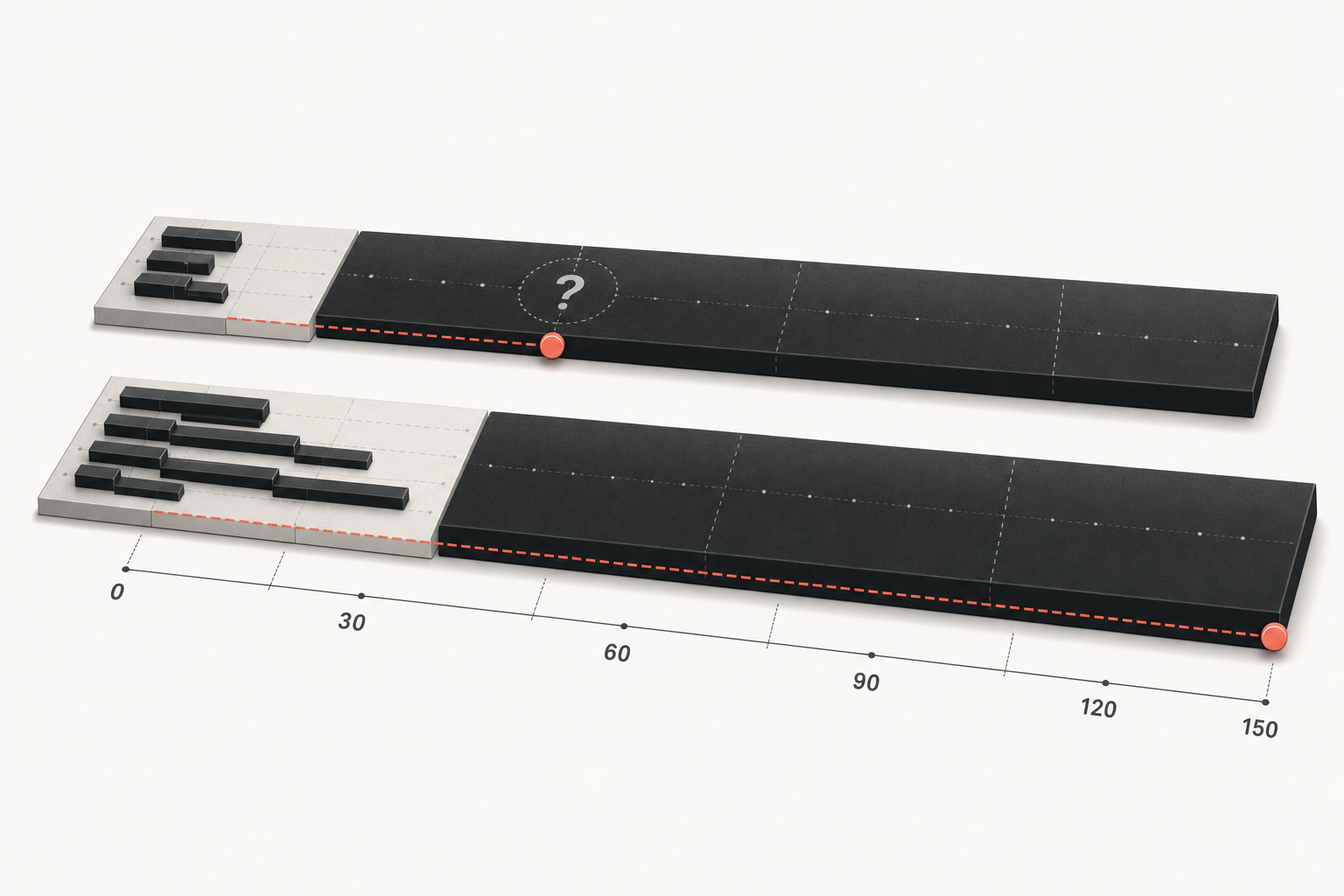
A contingency recruiter working a non-exclusive search with two competitors will invest roughly 8 to 12 hours before presenting candidates. They know from experience that spending 30 hours on a search they have a one-in-three chance of closing isn’t sustainable. The rational move is to front-load effort and present quickly.
A flat-fee recruiter working an exclusive search will invest 25 to 40 hours before presenting candidates. They run a full discovery process because their economics reward thoroughness. A wrong placement triggers the guarantee, which costs them far more than the extra time invested in getting the match right.
The difference isn’t quality of recruiter. It’s quality of incentive. The same person, responding to different fee structures, will make different decisions about how much time to invest, which concerns to raise, and when to present candidates.
Three Scenarios, Two Models
Here is what the total economics look like for three common agency hiring scenarios.
Scenario 1: Hiring a media buyer at $85,000.
Contingency fee (22%): $18,700. Time invested by the recruiter before presenting candidates: approximately 8 to 12 hours. Guarantee period: 60 days. What you keep if the search fails or you hire internally: nothing.
Flat fee: $7,500. Time invested before presenting candidates: approximately 25 to 40 hours. Guarantee period: 120 days. What you keep regardless of outcome: Right Person Profile, Work Environment Scan, Job Map, Salary Benchmark.
If the hire works and stays 18 months, you saved $11,200 in fees and received documented deliverables worth using in future hiring. If the hire fails at month three, you avoid a second fee under the flat-fee model and you already have the role definition documents for the replacement search. The contingency model charges you again.
Scenario 2: Hiring an account manager at $120,000.
Contingency fee (22%): $26,400. Flat fee: $7,500. The gap is $18,900.
But the gap in process is larger than the gap in price. At $120,000, the account manager role is senior enough that “good” and “great” are far apart. A good account manager keeps clients happy. A great one protects margins while building trust. The contingency recruiter’s 8-to-12-hour investment is unlikely to distinguish between these two profiles. The flat-fee recruiter’s discovery process maps exactly this distinction through Work Drivers assessment and a simulation designed to separate pleasers from protectors.
Scenario 3: Hiring a director of operations at $175,000.
Contingency fee (22%): $38,500. Flat fee: $7,500.
The contingency fee is now five times the flat fee. Both recruiters access the same labor market. Both can source qualified candidates. The question is whether the additional $31,000 purchases additional value. Under the contingency model, it doesn’t. It purchases the same process applied to a higher-salary role. Under the flat-fee model, the process is identical regardless of salary because the price is identical regardless of salary.
This reveals the core difference. Contingency fees scale with the salary of the role. Flat fees scale with the complexity of the discovery. These are two different theories of what drives hiring quality.
What You Keep
Most recruiting relationships end with a placement or a failed search. Either way, the client keeps nothing except the person (if the hire worked) or the experience (if it didn’t).
We deliver six artifacts during every engagement. Four of them are yours permanently, regardless of outcome.
The Right Person Profile maps who thrives in this specific seat. Not the job description. The behavioral and environmental profile that predicts 18-month retention. If you hire internally or use a different recruiter next time, this document tells them exactly what to look for.
The Work Environment Scan maps your company’s operating environment across the dimensions that predict fit. How decisions get made, how fast the pace runs, whether autonomy is real or theoretical. This document is useful for every hire you make, not just the one we searched for.
The Job Map is a 29-page candidate-facing document that shows the real work, the real environment, and the real expectations. Candidates read it and self-select. It reduces your interview volume because the wrong people opt out before you meet them.
The Salary Benchmark shows market-rate compensation for the specific role, experience level, and geography. You negotiate from data on this hire and every subsequent conversation about this role.
These deliverables represent roughly 60 percent of the value of the engagement. They exist because the fee structure pays for thoroughness. A contingency model can’t produce them because the economics don’t support investing 25 to 40 hours in a role you might not fill.
For a full comparison of what contingency agencies actually deliver versus what a discovery process produces, read what recruiting agencies do and what they skip.
The flat fee is not a discount. It is a different product. The deliverables, the guarantee, and the exclusivity are structural features of the fee model, not add-ons.
The Guarantee Math
Industry-standard recruiting guarantees run 60 days. Our guarantee runs 120 days.
This is not marketing. It’s actuarial.
Bad hires typically follow a pattern. In the first 30 days, they are learning the role and the organization is accommodating them. In days 30 to 60, they begin doing real work but are still receiving benefit of the doubt from the team. In days 60 to 90, the role’s full scope emerges and fundamental mismatches become visible.
By day 90, the hiring manager knows whether the person is right.
A 60-day guarantee expires before the real evaluation begins. The client discovers the problem at day 75 and has no recourse. They absorb the replacement cost and the second recruiting fee.
A 120-day guarantee covers the entire evaluation window. If the hire isn’t right, the replacement search is on us.
The math behind our guarantee confidence: 90% of our placements are still in role at 18 months. The industry average is approximately 58%. We can afford a 120-day guarantee because our process produces hires who stay. A contingency recruiter can’t afford the same guarantee because their process optimizes for speed, not retention.
The Question Behind the Question
The real comparison between fee structures isn’t about dollars. It’s about what the recruiter’s income depends on.
A contingency recruiter’s income depends on a placement happening. Every behavior follows from this. Present quickly. Present optimistically. Avoid raising concerns that might delay or kill the placement.
A flat-fee recruiter’s income depends on the placement being right. Every behavior follows from this. Invest time in understanding the role. Present honestly. Raise concerns early because a failed placement triggers the guarantee.
Both are rational responses to different incentive systems. Neither reflects the character of the individual recruiter. The structure produces the behavior.
If you want to start evaluating candidates differently today, here are 12 questions that predict whether your next hire will stick.
When you evaluate a recruiter, evaluate the structure first. Then evaluate the person. Our discovery process takes three hours of your time. We charge a flat $7,500 because our income depends on the placement being right, not on a placement happening. Every placement carries a 120-day guarantee, double the industry standard. 90% of our placements are still in role at 18 months.